Accessibility: actions and considerations
SAFEGUARDING FOUNDATIONS
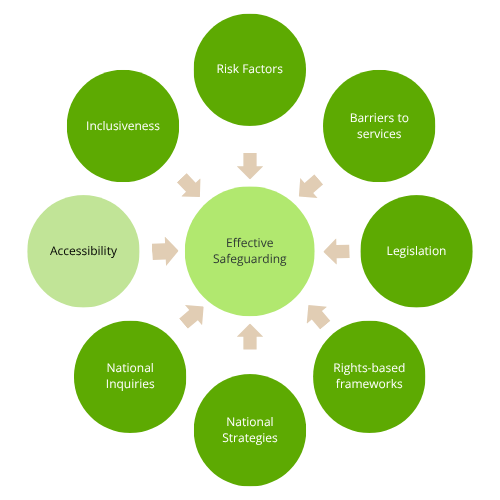
Accessibility and inclusiveness are core principles in effective safeguarding /whakahaumarutia. They work together to reduce harm, increase trust, and uphold dignity for disabled people engaging with your services. They enable better outcomes.
This section focuses on accessibility, and what this means for you, as a service provider.
Accessibility and Inclusiveness: Guidance for Safeguarding Providers in Aotearoa New Zealand
Accessibility removes barriers so disabled people can readily access, understand and use services.
Inclusiveness ensures disabled people are welcomed, respected and able to participate fully, when engaging with your staff (kaimahi) and your services.
What does this mean in practice for safeguarding providers in Aotearoa New Zealand?
Accessibility
Accessibility means making sure disabled people can access, understand, use and benefit from your services without barriers, so that people can participate fully and equally.
Barriers to people’s access to services can be physical, communication-based, digital, or systemic.
-
Ensure easy physical access at your office locations through providing ramps, lifts, accessible toilets, clear signage, safe entranceways.
-
Provide core information through:
plain English
translations into the main languages spoken locally
arranging interpreters for meetings/hui and conversations/kōrero where English is a second language
EasyRead versions for written material
(in hard copy or online)use of video clips or webinars to convey key information, and ideally with captions
making NZSL (New Zealand Sign Language) available as needed.
-
This requires:
clear language – which is easy to understand
adequate time for people to process information
well trained staff (kaimahi) who listen, are patient and seek to understand
simple, consistent and predictable processes and systems that keep the disabled person at the centre (more on this in the next item).
-
Consistent and predictable systems (and how your services are experienced) reduce uncertainty and anxiety.
This is especially so for people who: are neurodivergent (e.g. with autism or ADHD), are living with anxiety or trauma, have a learning disability, or rely on routine and clarity to feel safe.
Everyday changes, such as unclear processes, inconsistent staff responses, unexpected delays, or shifting rules, can trigger anxiety, shutdown, mistrust, or distress.
Source: Blue Squid Learning.
For disabled people who already are already requiring additional effort for navigating inaccessible environments, inconsistent systems can be exhausting and overwhelming.
Accessible buildings and services at your place
Many disabled people experience more than one disability,
which can increase accessibility needs.
Social model of disability
Ever thought about what it’s like to live in a world that wasn’t designed with you in mind? This film follows Sam, a non-disabled person in a world full of wheelchair uses. It’s a light-hearted film with a serious message about accessibility – and breaking down the barriers and embracing the Social Model of change.
Produced by the Welsh Government / Llywodraeth Cymru, 2021.
Think about accessibility in every area of your business
Accessibility is not just about wheelchair access.
Providers must review and improve:
buildings and spaces
printed materials
communication methods
online systems
policies and procedures.
For your action
A useful approach is to ask:
Can people access this communication, this building, this online system, or this policy safely and independently?
How easy or difficult is it for people to access, understand and use these key parts of my service?
Ask the people who use your services, directly – don’t guess or assume.
Create an action plan for your place, and track your progress and achievements:
so that you’re improving parts of your service and building accessibility every quarter (every 3 months)
until you’ve reached an appropriate standard.

If you’re not including disabled voices,
your services will have gaps in accessibility and inclusiveness.
VisAble’s Accessibility Statement
VisAble is mindful that our own products and services need to be accessible. We’ve made a good start, but there’s still a lot for us to do to reach the standard we’d like to achieve and to make our services and resources much more accessible to a wider range of disabled people.
Check out VisAble’s Accessibility Statement.

Keen to support the work we do?
If you’d like to help us develop a wider range of accessible features on our website, or help make our services available to a wider range of people and providers, please Donate to VisAble.