


Risk factors
SAFEGUARDING FOUNDATIONS
Aotearoa New Zealand continues to experience high rates of family violence and sexual violence, which significantly impact the safety and wellbeing of individuals, their families and whānau.
This section outlines the risk factors that providers and professionals need to become familiar with and consider when preparing referrals, risk assessments and safety plans.
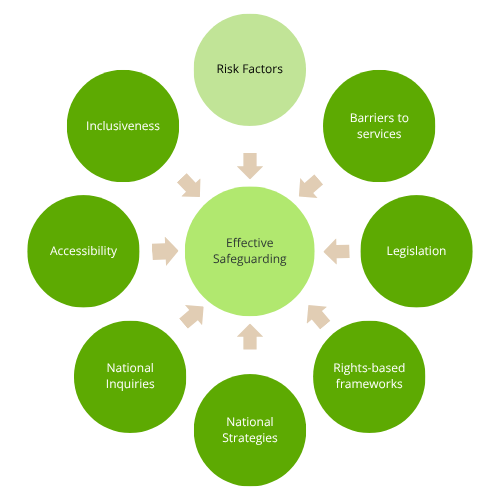

The Human Rights Commission notes there are significant gaps in:
how services are being designed to reduce risk of violence, abuse and neglect for disabled people
staff skills, knowledge, and attitudes
how well services work together.
These gaps make it harder for disabled people to get help and to stay safe.
They add to the risk.
Source: Human Rights Commission - Acting now for a violence and abuse free future.
why disabled people are more at risk of violence and abuse
Here are some of the risk factors that can impact disabled people and increase the risk of violence, abuse and neglect. The information is also available as a hand-out, for use in identifying and assessing risk.
-
Violence is linked to ableism – which is a form of discrimination. For people who have ableist attitudes and beliefs, disabled people are sometimes seen as less important, less believable, or easier to control — which increases their risk of violence, abuse or neglect.
Harm is often ignored or treated as normal.
When abuse is not taken seriously for a long time, people may start to think it is just part of everyday life.This can happen:
in a disabled person’s own home or flat
in residential care or supported living services
it can also include disabled people being violent towards others.
Discrimination gives some people more power than others.
When disabled people have less power, they’re more at risk of violence, abuse and neglect, and may find it harder to get help or stay safe. -
When people don’t get the communication support they need, it becomes much harder - and sometimes unsafe - for them to speak up about abuse or neglect. For example, if people need access to:
interpreters
accessible information (i.e. that’s easier to understand and use)
assistance to enable them to express themselves.
If someone’s communication is controlled or restricted, they may not be able to reach out for help at all.
-
When someone relies on others for daily tasks (such as transport, personal care, or communication), those providing support may be able to control or block access to important things such as money, devices, information, or safe people.
Caregivers and others charged with providing support may have (and hide) attitudes and behaviours that reduce dignity, respect, confidence and trust.
In these circumstances, dependence can make it hard to leave an unsafe situation or ask for help, because doing so might mean losing the support needed for everyday life.
-
Some people may not realise they are being harmed, especially if the abuse has been happening for a long time, has been made to look like ‘care’, is caused by someone the disabled person trusts, or has become normal in their everyday life.
Some people need support to make decisions.
People may avoid seeking help because they’re scared or shut down, have had bad experiences before, find communication difficult, or worry that others won’t believe them.
-
Being treated differently or excluded can isolate disabled people, which can increase the influence and control others have over them.
Social isolation increases risk because it reduces access to trusted people, limits opportunities to disclose harm, and makes it easier for abuse to remain hidden.
Isolation can also be created on purpose – when a person with more power limits another person’s movements, relationships, or communication. This makes it much harder for them to reach out for help or find safety.
-
The risk of a disabled person experiencing violence, abuse, or neglect increases when disability overlaps with other ways they might be left out or treated unfairly in society - such as due to their ethnicity, gender, economic status or money worries, or sexuality.
Called intersectionality, these factors can stack up, interacting with systems and services, and often making discrimination and harm more likely and making it harder to access support and safety. -
If services don’t have safe and accessible reporting systems; don’t have systems and culture in place to prevent harm; don’t adequately detect abuse or respond properly; and don’t make support accessible, disabled people miss out on their basic rights and on safety and security.
Disabled people can be left unsafe and can stop believing that there is a solution to their problem.
-
Institutional (or organisational) risks are the systemic conditions within organisations, services, or care environments that increase the likelihood of abuse or neglect. These risks arise from structures, policies, routines, cultures, or power arrangements rather than from isolated acts by individuals.
In disability settings, institutional risks are heightened because disabled people may rely on organisations for daily living support, communication, decision-making, health care, personal care, or safety. Where oversight is weak or power is concentrated with providers rather than service users, abuse can occur, and harmful practices can become normalised, overlooked, or justified as “routine care.”
The findings of New Zealand’s Royal Commission of Inquiry into Abuse in Care show how organisational cultures, weak regulation, and power imbalances enabled widespread abuse of disabled people in state and faith-based care.
Institutional risks arise not from a single incident,
but from the way services are designed,
managed, and routinely operated,
particularly where power imbalances,
rigid systems, or poor oversight exist.


Compounding risks - intersectionality
There might be several risk factors interacting at any given time, compounding the situation (i.e. making it more complex) and increasing the risk of the person experiencing violence, abuse or neglect:
Overlapping risks (such as disability, poverty, racism, gender identity, or social exclusion and isolation) can increase the likelihood of harm, and are called “intersectionality” – or compounding risks.
Where there are compounding risks, there is an increased likelihood of disadvantage and discrimination occurring. This leads to an increased risk of violence, abuse or neglect.

Service environments that provide disability support can themselves pose risk to disabled people if:
organisational culture and staff practices don’t address (and in fact normalise) inappropriate behaviour
staff or other residents commit abuse
organisations lack clear systems for preventing, detecting and reporting abuse.
References:
Health and Disability Commissioner – Case notes and decisions.
White Ribbon NZ – Disability and violence risk factors .
Role of providers and professionals

The awareness and analysis of risk is fundamental
to an effective risk assessment and safety plan.
Risk factors need to be identified and included in risk assessments and safety plans, and ideally in referrals, to enable effective interventions and safety outcomes to be achieved and sustained.
That means that providers and professionals need to be ‘environmentally aware’ – taking account of the social context in which violence, abuse and neglect might be happening, as well as the more immediate, obvious and personal factors that are affecting disabled people who are experiencing, or are at risk of, violence, abuse or neglect.
For your action
Being familiar with these risk factors helps to enable effective interventions and safety outcomes to be achieved and sustained.
Learn how to identify the risk factors, including compounding risks (see training opportunities below).
Include the relevant risk factors in risk assessments and safety plans, and in referrals.
Risk factors and safeguarding
Effective safeguarding / whakahaumarutia relies on the ability to identify and address the risk factors affecting disabled adults who are experiencing, or are at risk of, violence, abuse or neglect.
Safeguarding guidelines emphasise:
strategies to prevent violence, abuse or neglect
how to detect abuse: recognition of risk factors and signs of abuse
reporting and responding to incidents
preparing risk assessments and safety plans
organisational learning.

Access to training
VisAble offers interactive training to help you develop a deeper understanding of these topics and why they’re important.
The training also enables you to explore how to apply the information at your place, with your staff (kaimahi) and in your services, to make a difference for disabled people.
We can also provide training for tāngata whaikaha Māori, disabled people, families, whānau and caregivers.
Find out more about our training and resources Or contact us at info@visable.co.nz.